Friday, September 9, 2011

Intimate


Intimate is a word that I use quite often, but probably not how you imagine.

The first usage (which often means that it is the most common) is an adjective and describes close, personal relationships. It is pronounced [in-tuh-mit]. The following sentences give an array of meaning with this definition:

I have an intimate relationship with my husband.
The cafe offered an intimate atmosphere.
Handling my finances is an intimate affair.

Do you see how they all result in a "close to" meaning?

The way I use this word is the second and less common usage of hinting, implying or suggesting. In this case, it is a verb. It is pronounced [in-tuh-meyt]. A few sentences:

I didn't not mean to intimate that I don't like the color.
Are you intimating that you want to go?

For some reason, you will see this usage in written form much more often than hear it in conversation. I am not sure why, other than the fact that many people may simply not be comfortable using it. I am certainly not intimating that they are ignorant.

Thursday, September 8, 2011

Luddite

While watching the Republican presidential debates on television last night, one of the commentators used the word Luddite when referring to a candidate's outlook on the economy. I believe he said, "His Luddite mentality with regard to the economy." I immediately ran to the dictionary!

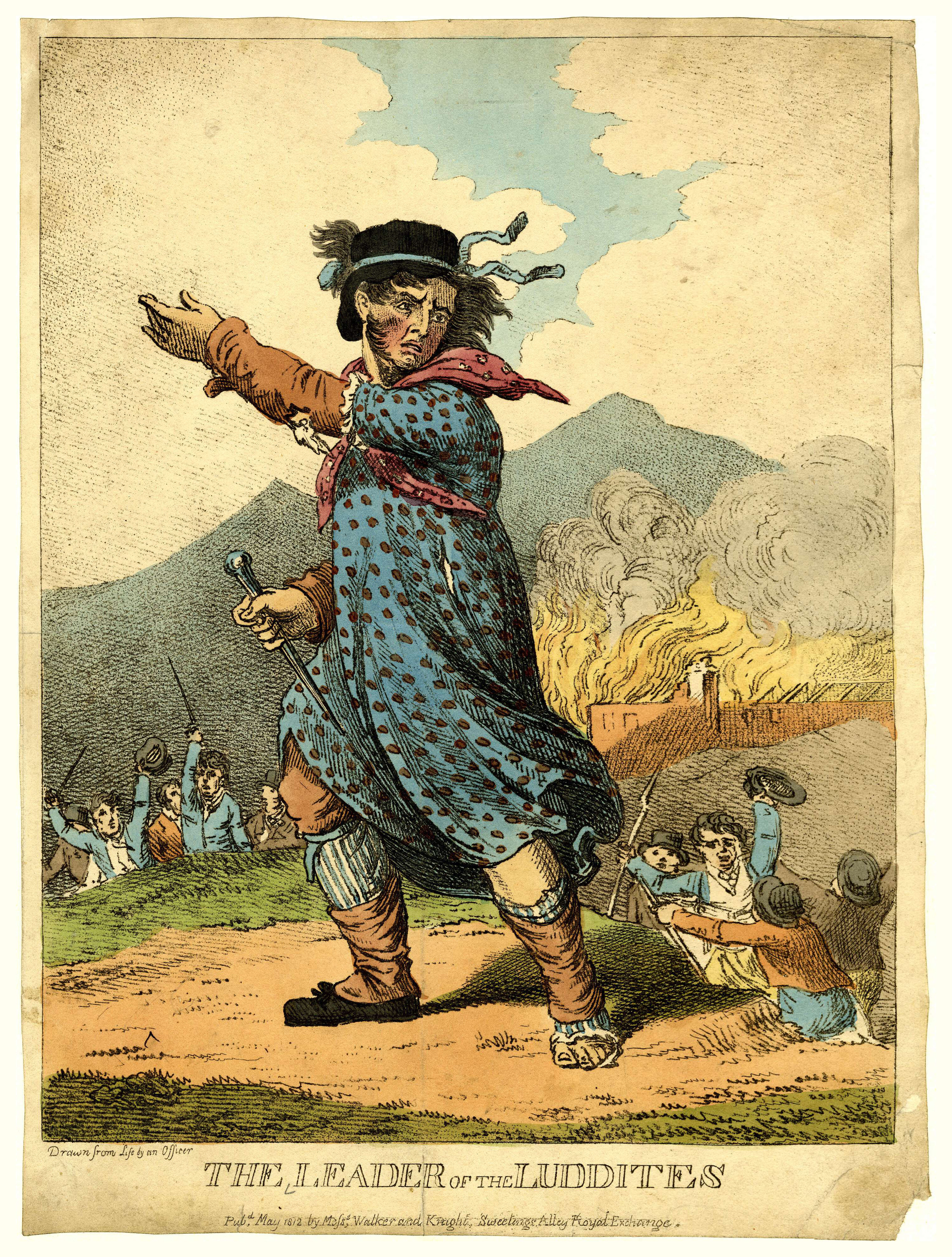
File:Luddite.jpgWhen the Industrial Revolution was sweeping across England, skilled textile workers found themselves out of a job, and unable to find other, similar work. Textile workers, more specifically hosiery and lace weavers, began to meet secretly, planning the destruction of new mechanized looms. They signed their threatening letters and cases of industrial sabotage with the fictional name King Ludd.

Much like a Robin Hood-type figure, King Ludd was anonymous and stood for a principle rather than a real person. Some accounts even have King Ludd as living in Sherwood Forrest.

Often painted as technophobes, Luddites were more likely trying to save the essence of their industry. They considered themselves artisans and not merely weavers. They were creating items meant to be passed down from generation to generation. This did not include mass-produced, identical, cheaply made items. The only way they could have their voice heard was through the destruction of the machines that threatened, not only their livelihood, but also their art and the reputation of their trade.

Wednesday, September 7, 2011

Is it Fall or is it Autumn?


The word autumn comes from the Old French word autompne (automne in modern French), and was later normalised to the original Latin word autumnus.There are rare examples of its use as early as the 12th century, but it became common by the 16th century.

Before the 16th century, harvest was the term usually used to refer to the season, as it is common in other West Germanic languages to this day. However, as more people gradually moved from working the land to living in towns (especially those who could read and write, the only people whose use of language we now know), the word harvest lost its reference to the time of year and came to refer only to the actual activity of reaping, and autumn, as well as fall, began to replace it as a reference to the season.

The alternative word fall for the season traces its origins to old Germanic languages. The exact derivation is unclear, the Old English fiƦll or feallan and the Old Norse fall all being possible candidates. However, these words all have the meaning "to fall from a height" and are clearly derived either from a common root or from each other. The term came to denote the season in 16th century England, a contraction of Middle English expressions like "fall of the leaf" and "fall of the year".

During the 17th century, English emigration to the British colonies in North America was at its peak, and the new settlers took the English language with them. While the term fall gradually became obsolete in Britain, it became the more common term in North America.

So, either one you choose to use, use it while holding a cup of tea and wearing your favorite sweater!

Tuesday, September 6, 2011

Okay, let's get this going again!


Now that Dana is married (YES!! MARRIED!!!) and I have no excuse whatsoever, I am going to get our site started again with a random post.

Guess what it's been doing since Sunday. Yep! Raining cats and dogs! Where on earth did that saying generate?

Here is a very good summary of several possible etymologies from the Ask Yahoo site:

As with many such questions, the jury is out on this one. World Wide Words offers several possible derivations for the saying, including an old sailor's myth that cats have sway over the weather. Feline meteorological magic, coupled with a symbolic association of storms with dogs, may be the genesis for the phrase. But we can't be sure.


The chatty etymology newsletter Take Our Word For It mentions another intriguing possibility. On account of the notorious inefficiency of 17th-century sewage and drainage systems, the streets of European cities were often littered with debris and dead animals after heavy rainstorms. They had to come from somewhere, right?

Animalplanet.com offers yet two more possibilities for this colorful expression. It could liken the racket made by a storm to the thunderous noise made by fighting cats and dogs. Or, it may arise from the era of thatched roofs when downpours would bring cats and dogs dozing atop houses down onto the occupants.

A general interest weather site run by Wheeling Jesuit University traces the history of raining wildlife. There are several accounts of frogs, fish, and grasshoppers falling from the sky, usually as a result of tornado-like whirlwinds. Cats and dogs, however, have yet to make the list.

The leading theory seems to be that animals have been associated with weather for centuries. Cats stand for rain, and dogs for wind.

There you have it! That is UNCANNY!

Monday, November 29, 2010

Congratulations!!

Well, it's official!

Brian and Dana, sitting in a tree...headed to matrimony.

In keeping with the theme, use these synonyms for "engaged" when you congratulate the happy couple.

Affiance
Betroth
Espouse

All have the same meaning: "intent to marry".

Monday, November 22, 2010

NPR is expanding my vocabulary!

I was listening to Fresh Air on National Public Radio last week, and heard a story on Jane Austen. During the course of the discourse (haha), several words were used that I had to jot down, with the sole purpose of bringing them to you:

Idiom: the language peculiar to a people or to a district, community, or class

Querulous: habitually complaining

Juvenilia: compositions produced in the artist's or author's youth

Anachronism: an error in chronology; especially : a chronological misplacing
of persons, events, objects, or customs in regard to each other

Pedantry: narrowly, stodgily, and often ostentatiously learned

Strew: to spread by scattering

Obtuse: lacking sharpness or quickness of sensibility or intellect

The piece, in particular, deals with the allegations that Jane Austen was a "sloppy writer", not able to spell or use punctuation correctly. I loved this sentence, as the narrator (linguist Geoff Nunberg) summed up his notion of anyone clucking their tongues as they apply what is a modern-day-notion of correctness:

"It's nice to know where a semi-colon's supposed to go, but it's nothing to swell your chest over. The artistry is in being able to write sentences that require one."

Well said!

Wednesday, November 3, 2010

Kerfuffle

Recentley NPR announced that it was firing news analyst Juan Williams because of his remarks about airplane passengers dressed in traditional Muslim clothing.

Kerfuffle was often used to describe this affair. For example:

"Liberals and conservatives alike were quick to elevate this kerfuffle into a larger battle of good-versus-evil over issues such as public financing of NPR or First Amendment guarantees, but it doesn't need to go there." – Armstrong Williams, The Hill's Pundits Blog, October 22, 2010

A fancy word for "disturbance" or "fuss," kerfuffle is often used to describe an exchange or encounter of exaggerated importance.

It's a popular word in British English, currently gaining popularity in the U.S.

Kerfuffle comes from Scottish Gaelic words meaning "awkward" and "disheveled."