Friday, September 16, 2011

Synecdoche

Here's a hard one for you today! Synecdoche

\sə-ˈnek-də-kē\

Definition:
A figure of speech by which a part is put for the whole (as fifty sail for fifty ships), the whole for a part (as society for high society), the species for the genus (as cutthroat for assassin), the genus for the species (as a creature for a man), or the name of the material for the thing made (as boards for stage)
Etymology:
Latin, from Greek synekdochē, from syn- + ekdochē sense, interpretation, from ekdechesthai to receive, understand, from ex from + dechesthai to receive; akin to Greek dokein to seem good
 
Now, this is more common that you may think. From the definition, it is still a little difficult to grasp the true meaning, and the wildly abundant usage of this linguistic term. For a plethora of examples of usage, I turned to Wikipedia.
 
A part referring to the whole
  • Prominently used in slang and vulgar speech, where the entire person is referred to by their genitalia.
  • Referring to people according to a single characteristic: "the gray beard" representing an older man or "the long hair" representing a hippie. This leads to bahuvrihi compounds.
  • Describing a complete vehicle as "wheels"
  • Calling workers "hands", e.g. Many hands make light work; All hands on deck!
  • Before and during the Cold War, the Soviet Union was commonly referred to by its largest and most well-known member, Russia.
  • Use of the names England (only one of the four constituent nations) or Great Britain (the geographical name of the main island) to mean the entire United Kingdom.
  • Use of Holland, a region of the Netherlands, to refer to the entire country
The name for a whole when used to describe one part of it
  • In the United States, terms like "United States", "(the Commonwealth of) Virginia" or "(the) People (of the State of California)" are used in court trials when the plaintiff, prosecutor or defendant is a government entity, such as in Loving v. Virginia.

A general class name used to denote a specific member of that or an associated class
  • "the good book," or "The Book" for the Bible
  • "truck" for any four-wheel drive vehicle (as well as long-haul trailers, etc.)
  • "He's good people." [Here, the word "people" is used to denote a specific instance of people, i.e. a person. So the sentence would be interpreted as "He's a good person.")
A specific class name used to refer to a general set of associated things
  • "John Hancock" for the signature of any person
  • a genericized trademark, for example "Coke" for any variety of cola or "Band-Aid" for any variety of adhesive bandage
  • "bug" for any kind of insect or arachnid, even if it is not a true bug
The material that a thing is (actually, historically, or supposedly) made of referring to that thing
  • "glasses" for spectacles
  • "steel" for a sword
  • "tin" for a container made with tin plating
  • "willow" for a cricket bat or "pigskin" for an American or Canadian football
  • "wood" for a type of club used in the sport of golf
  • "irons" for shackles placed around a prisoner's wrists or ankles to restrict their movement
  • "plastic" for a credit card (asking a merchant) Do you take plastic?
  • "lead" for bullets (e.g. They pumped him full of lead.)
  • "silver" for flatware or other dishes that were once made of silver metal
  • "rubber" for a condom
  • "threads" for clothing Yo, check out my new threads!
A container is used to refer to its contents
  • "barrel" for a barrel of oil
  • "keg" for a keg of beer
See? You probably use this figure of speech several times a day. Now you know what it's called!

Thursday, September 15, 2011

Glean

Glean \ˈglēn\

intransitive verb
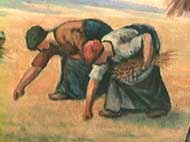
1: to gather grain or other produce left by reapers
2: to gather information or material bit by bit

transitive verb
1a : to pick up after a reaper b : to strip (as a field) of the leavings of reapers
2a : to gather (as information) bit by bit b : to pick over in search of relevant material <gleaning old files for information>

During my Bible Study class last night, the teacher told the Greek word and meaning for a very common word in scripture (I believe it was favor), and I was surprised at the rich and meaningful definition of the Greek word, as opposed to the word used in my translation. I said, "Wow, I didn't glean that from my reading."
 
This made me think of the word glean. It's a word that is commonly known, but not commonly used. Why not? You hear often, "I didn't get that from the passage," or "I didn't understand that from the passage."
 
To use the word glean here is so much more encompassing and active than the above examples. It's use implies that the person was trying to understand the text, trying to lean, and trying to get more information. There is in innate feeling of difficulty in the word, as if there is a struggle or, at the very least, work done to get to this knowledge. Otherwise, the reader is passive, waiting for information to be handed or given to him.
 
The fact that glean originates from an extinct Celtic language is enticing enough for me to use it more often. It has certainly stood the test of time! Try to incorporate the word glean into your vocabulary and enrich your communication.

Wednesday, September 14, 2011

Pugnacious

Famed movie critic Roger Ebert has a new memoir coming out. In honor of him and his contribution (as in being the first film critic to win the Pulitzer Prize), we have our word for today: pugnacious.

\pəg-ˈnā-shəs\
Definition:
having a quarrelsome or combative nature
 
Etymology:
Latin pugnac-, pugnax, from pugnare to fight
 
Why is pugnacious associated with Ebert, you wonder? Ebert co-hosted a television show with Gene Siskel for over 20 years. I loved to watch the show, waiting for the final thumbs-up or thumbs-down from each of them. They disagreed a lot, which made their relationship seem pugnacious.
 
Specifically, I remember a review in 1994 of The Lion King, where Siskel loved the song Hakuna Matata, stating that he often sang it aloud. Ebert challenged him on it, saying that he had never heard him sing it and he was glad because he didn't like the song. Siskel shot it right back to him, stating that he didn't sing it in his hearing in deference to him.
 
Click here for a reel of outtakes from recording promos. You can clearly see that they were extremely pugnacious.

Tuesday, September 13, 2011

Non Sequitur

My kids like to read the comics in the daily newspaper. Recently, one of them asked me what the comic title "Non Sequitur" means.

NonSequitur.pngThe Non Sequitur comic features characters from the fictional town of Whatchacallit, Maine. Created by Wiley Miller, t is the only comic strip to win in its first year of syndication and the only title to ever win both the best comic strip and best comic panel categories. It is, by turns political, satirical and comedic.

\ˈnän-ˈse-kwə-tər also -tu̇r\

Definition:
an inference that does not follow from the premises; specifically : a fallacy resulting from a simple conversion of a universal affirmative proposition or from the transposition of a condition and its consequent result.

Example: We were talking about the new restaurant when she threw in some non sequitur about her dog.
 
Etymology: Literally, the expression is Latin for "it does not follow." It comes from the words "non" meaning not, and the deponent verb sequor, sequi, secutus sum, meaning to follow.

So, why would this latin term apply to this comic? Tell me what you think.

Monday, September 12, 2011

Is God a Bulwark?

Yesterday in church, we sang A Mighty Fortress is our God, with the following words:
Definition Of Bulwarkthumbnail

A mighty fortress is our God,
a bulwark never failing

What on earth is a bulwark (pronounced ˈbul-wərk, -work)?

Definition: a solid wall-like structure raised for defense.

Well, that certainly makes sense, but can't we just say He is a ... well, a mighty fortress? Where does this word originate?

Bulwark is a noun that has its sources in Middle English and Middle Dutch from the 15th century. In Middle English it comes from the word "bulwerke." In Middle Dutch it comes from the word "bolwerk." The components of the Dutch origin are "bolle" (tree trunk) and "werc" (work).

It seems to be more a military term than anything, and with that in mind, I can certainly see why a songwriter would use it in a hymn. The word fortress is very descriptive, but I find the essence of bulwark to be much stronger when spoken. To pronounce fortress is to keep the sounds at the front and top of the mouth. Bulwark comes from the back and bottom of the mouth, with the throat fully engaged, ending in a gutteral hard "k" ending. It is much more fulfilling to speak and get the idea across of a fully-engaged, from the bottom-up kind of God-protection.

Is God a bulwark? Yes! He is!

Sunday, September 11, 2011

Memories Never Die


A pair of 8' bronze hands holding a twisted steel I-beam salvaged from the North Tower of the World Trade Center.

Saturday, September 10, 2011

Ennui


This is an unusual word to hear, and I ran into it TWICE this week!

Jim and I were watching "Yes Man", a movie starring Jim Carey, where they used this word. When I was surprised at the usage, Jim told me that the band Live uses it in the lyrics to the song "Rattlesnake".

Definition:  a feeling of weariness and dissatisfaction; boredom

Example: the kind of ennui that comes from having too much time on one's hands and too little will to find something productive to do

Etymology: French, from Old French enui annoyance, from enuier to vex, from Late Latin inodiare to make loathsome